Cleared Hot: What F-18 Combat Doctrine Teaches Us About Winning in Volatile Markets
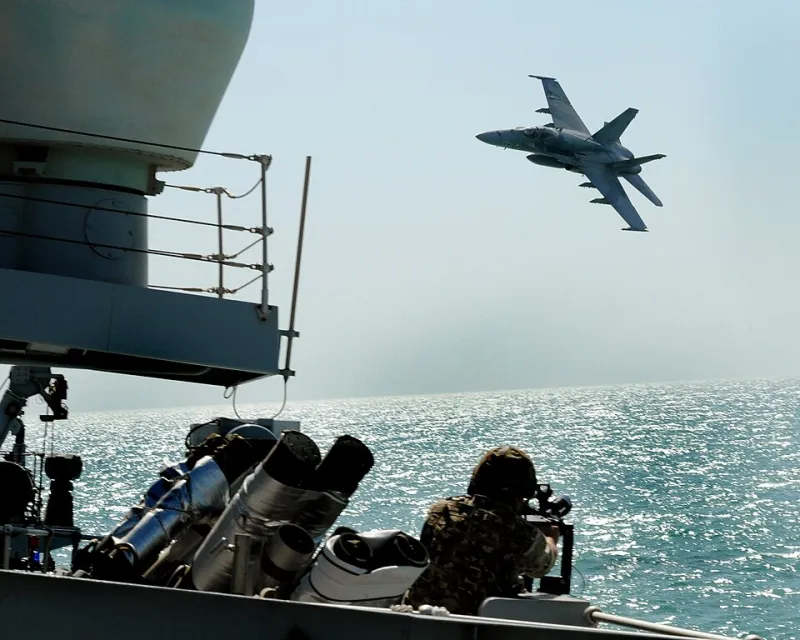
Photo: LA(Phot) Simmo Simpson, OGL v1.0, via Wikimedia Commons
When the Cockpit Meets the Conference Room
At 30,000 feet, traveling faster than the speed of sound, an F/A-18 pilot does not have the luxury of deliberation. Every decision carries consequence. Every second of hesitation has a cost. The aircraft's systems, the pilot's training, and a rigorous operational doctrine converge into a single, unified capability: the ability to act decisively under conditions of extreme uncertainty.
Now consider the modern American boardroom. Markets shift without warning. Competitors pivot overnight. Regulatory environments evolve faster than most strategic plans can accommodate. The parallels between aerial combat and corporate competition are not merely metaphorical—they are structural. And a growing number of Fortune 500 executives are beginning to recognize that the frameworks governing fighter jet operations offer a genuinely superior model for high-stakes business strategy.
At F18 Consulting, this recognition is not a marketing concept. It is the foundational philosophy behind every engagement we undertake.
The OODA Loop: From Air Combat to Competitive Advantage
Military strategists have long relied on a concept developed by Air Force Colonel John Boyd: the OODA Loop—Observe, Orient, Decide, Act. Originally designed to explain how fighter pilots gain and maintain dominance in aerial engagements, the OODA Loop has since been adopted by special operations units, intelligence agencies, and, increasingly, by sophisticated corporate strategists.
The principle is straightforward but profound. The pilot—or the organization—that cycles through the loop faster than its adversary seizes the initiative. It is not simply about speed, however. Orientation, the second stage, is where competitive advantage is truly forged. Orientation encompasses an organization's accumulated knowledge, its mental models, its cultural assumptions, and its analytical capabilities. A company with superior orientation doesn't just react faster—it perceives threats and opportunities that competitors cannot yet see.
Consider how this played out during the rapid digital disruption of the retail sector. Companies that had invested in robust market intelligence infrastructure and cultivated adaptive organizational cultures were able to cycle through the OODA Loop with greater agility than legacy competitors still operating on annual planning cycles. They observed shifting consumer behavior earlier, oriented their strategic lens accurately, decided with conviction, and acted before the window closed. Those that could not match this tempo were left responding to conditions that had already changed.
Situational Awareness as a Strategic Asset
Another concept central to F-18 operations is situational awareness—the comprehensive, real-time understanding of one's operational environment. In aviation, degraded situational awareness is a primary contributing factor in accidents and mission failures. A pilot who loses the picture, as aviators say, becomes reactive rather than proactive, and reactive pilots do not survive complex engagements.
In business, situational awareness translates directly to competitive intelligence, market sensing, and the quality of information flowing through an organization's decision-making channels. Many companies operate with dangerously incomplete pictures of their competitive landscape. They rely on lagging indicators, outdated market research, or internal data that confirms existing assumptions rather than challenging them.
Building genuine situational awareness requires investment in multiple intelligence streams: customer behavior analytics, competitive monitoring, regulatory horizon scanning, and macro-economic indicators. More importantly, it requires the organizational discipline to synthesize that information rapidly and translate it into actionable strategic guidance. This is precisely where a rigorous consulting methodology—one designed around precision rather than generality—delivers disproportionate value.
Weapons Free: The Art of Decisive Execution
F-18 pilots train relentlessly for a concept known as weapons employment—the precise, calibrated application of force at the exact moment and location where it will achieve the desired effect. Imprecise weapons employment wastes resources, creates unintended consequences, and frequently fails to achieve mission objectives. Precision, by contrast, achieves decisive results with minimal expenditure.
The corporate equivalent is strategic resource allocation. Many organizations disperse their capital, talent, and attention across too broad a front, diluting impact and generating mediocre outcomes across multiple initiatives rather than decisive results in a focused few. The most strategically sophisticated companies—those that consistently outperform their sectors—tend to exhibit a fighter-pilot-like discipline in concentrating force. They identify the highest-leverage opportunities, commit resources with conviction, and execute with a precision that competitors find difficult to match.
This approach demands both analytical rigor and organizational courage. Concentrating resources means making explicit choices about what not to pursue, a discipline that runs counter to the natural institutional tendency to hedge. Yet the historical record is clear: focused, precision-driven strategies consistently outperform diversified, coverage-based approaches in dynamic competitive environments.
Mission Planning: Why Strategy Without Rehearsal Is Incomplete
Before every flight, F-18 pilots conduct exhaustive mission planning. They study the threat environment, rehearse contingency responses, establish decision points, and define abort criteria—conditions under which the mission will be discontinued regardless of the pressure to continue. This pre-mission architecture allows pilots to make complex decisions in real time without cognitive overload, because the decision framework has already been established.
Organizations that approach strategic initiatives with equivalent rigor consistently outperform those that launch programs with incomplete planning. Establishing decision points—predetermined thresholds at which strategic assumptions will be reviewed and course corrections will be considered—is particularly valuable. It removes the emotional and political friction that typically delays necessary pivots, replacing it with a structured, rational review process.
Defining abort criteria is equally critical. Many corporate initiatives persist long past the point of viability because no one established, in advance, the conditions that would warrant discontinuation. The result is wasted capital, demoralized talent, and opportunity cost that compounds over time.
Precision as a Competitive Doctrine
The F-18 is not the largest aircraft in the inventory, nor the most heavily armed. Its enduring effectiveness derives from the integration of precision systems, highly trained operators, and a doctrine that prioritizes disciplined execution over brute-force application of resources. That integration—of capability, expertise, and methodology—is precisely what distinguishes transformational business strategy from conventional advisory.
At F18 Consulting, we believe that American businesses operating in today's environment face conditions that demand a fundamentally different strategic approach. Markets are more volatile, competitive cycles are shorter, and the consequences of strategic miscalculation are more severe than at any previous point in the modern business era.
The organizations that will define the next decade of American commerce are those that adopt the discipline, precision, and adaptive decision-making that fighter aviation has refined over generations of high-stakes operational experience. The cockpit and the conference room are closer than most executives realize—and the lessons flowing from one to the other may be among the most valuable strategic insights available today.